Ohio
Ohio Garden Pests Now
Ohio has a statewide spotted lanternfly quarantine, effective February 17, 2026, and all 88 counties are on the Ohio Department of Agriculture map. This page lists 4 quarantine and detection entries and 20 pest timing entries from 20 official sources.
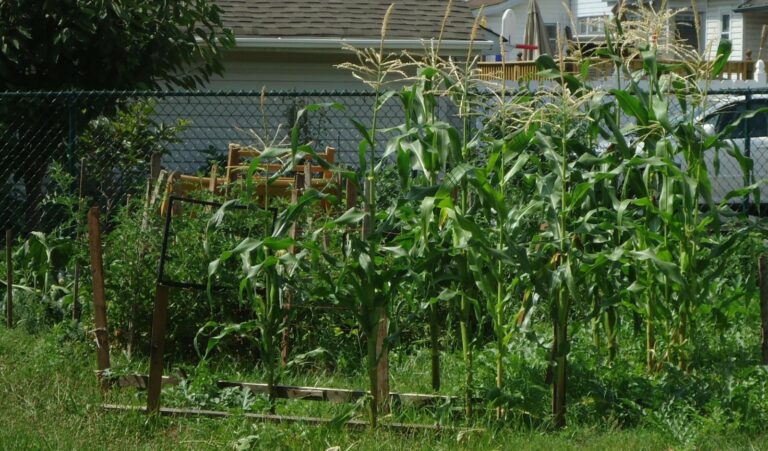
Photo: Tall corn and other vegetables growing in a fenced backyard garden. Tomwsulcer, CC0, via Wikimedia Commons
Pest quarantines that apply in Ohio
The date is the one the source prints, if any.
| Pest | Status as printed | Counties | As of | Source |
|---|---|---|---|---|
| Spotted lanternfly Lycorma delicatula | Statewide quarantine effective February 17, 2026 (previously 18 counties) | Statewide (88 counties named) | Updated February 2026 (ODA map); February 17, 2026 (effective date) | Ohio Department of Agriculture Issues Statewide Quarantine to Combat Spotted |
| Box tree moth Cydalima perspectalis | Quarantine zone expanded to include seven new counties (January 30, 2026) | 14 counties listed | January 30, 2026 | Seven New Counties Added to the Ohio Box Tree Moth |
| Asian longhorned beetle Anoplophora glabripennis | Quarantine zone covers 44 square miles in Clermont County (Tate Township area); 5.2 sq mi deregulated March 2025 | 1 county listed | page date May 15, 2018; includes March 2025 update | Asian Longhorned Beetle |
| Spongy moth Lymantria dispar | Quarantine rule in effect (OAC 901:5-52); regulated areas are USDA 7 CFR 301.45 areas plus ODA-designated areas; Ohio county list not printed on pages read | No county list printed | rule effective October 3, 2024 | Rule 901:5-52-04 Regulated area |
Spotted lanternfly: 88 counties named in the source
Adams, Allen, Ashland, Ashtabula, Athens, Auglaize, Belmont, Brown, Butler, Carroll, Champaign, Clark, Clermont, Clinton, Columbiana, Coshocton, Crawford, Cuyahoga, Darke, Defiance, Delaware, Erie, Fairfield, Fayette, Franklin, Fulton, Gallia, Geauga, Greene, Guernsey, Hamilton, Hancock, Hardin, Harrison, Henry, Highland, Hocking, Holmes, Huron, Jackson, Jefferson, Knox, Lake, Lawrence, Licking, Logan, Lorain, Lucas, Madison, Mahoning, Marion, Medina, Meigs, Mercer, Miami, Monroe, Montgomery, Morgan, Morrow, Muskingum, Noble, Ottawa, Paulding, Perry, Pickaway, Pike, Portage, Preble, Putnam, Richland, Ross, Sandusky, Scioto, Seneca, Shelby, Stark, Summit, Trumbull, Tuscarawas, Union, Van Wert, Vinton, Warren, Washington, Wayne, Williams, Wood, Wyandot.
Products such as trees and nursery stock may not be moved out of Ohio without a compliance agreement, permit, or inspection certificate. OAC regulated articles include plants and plant parts, firewood and logs.
Box tree moth: 14 counties named in the source
Miami, Montgomery, Greene, Butler, Clermont, Hamilton, Warren, Preble, Clark, Cuyahoga, Ashtabula, Lorain, Lake, Lucas.
No person shall transport regulated articles from a regulated area into or through a non-regulated area in Ohio (OAC 901:5-58-01); nursery producers can use an ODA Compliance Agreement.
Asian longhorned beetle: 1 county named in the source
Clermont.
Firewood, stumps, roots, branches, debris and other material from all hardwood species restricted from leaving the quarantine area.
Statuses and county names are copied from the listed pages. A county that is not named is not marked clear: check the department page for the current order before moving plants, firewood or soil.

Green crop field and farm buildings at Wiers Farm, Huron County
Ohio garden pests by season, from extension pages
The box filters every row.
| Pest | Stage | When, as printed | Plants | Advice as printed | Source |
|---|---|---|---|---|---|
| Box tree moth | Caterpillars (overwintering) | Resume feeding on boxwood leaves early in spring; split generation between fall and spring | Boxwood (Buxus) | Early spring insecticide applications targeting the overwintered caterpillars are critical. | Seven New Counties Added to the Ohio Box Tree Moth |
| Box tree moth | Generations | Three complete generations in southern Ohio | Boxwood (Buxus) | Report suspected infestations to ODA via the Ohio Plant Pest Reporter tool (per bygl-btm-monitor). | Seven New Counties Added to the Ohio Box Tree Moth |
| Japanese beetle | Adults | Emerge from the last week of June through July | Over 400 species of broad-leaved plants incl. roses, flowering cherry, zinnias; about 50 preferred | Traps do not significantly reduce grub populations and may increase foliar feeding damage. | Japanese Beetle |
| Japanese beetle | Eggs/adults | About 95% of eggs laid by mid-August; adults may be found until first frost | Turfgrass roots (grubs) | Japanese Beetle | |
| Japanese beetle | Grubs (spring) | Feeding at the surface when surface soil temperature reaches 65°F, usually in mid-April | Turfgrass | Japanese Beetle | |
| Japanese beetle | Grubs (curative timing) | First and second instars, August through first week of September | Turfgrass | Curative products (dinotefuran, trichlorfon, clothianidin) work best in this window; after it only trichlorfon may work, watered in immediately. | Japanese Beetle |
| Japanese beetle | Pre-pupa | Early June | Japanese Beetle | ||
| Japanese beetle | Adults | On the wing in southern and central Ohio (observation dated June 21, 2017) | Japanese Beetles and Masked Chafers on the Wing | ||
| Periodical cicada | Nymphs (emergence) | Mass emergence once average soil temperature reaches 64°F at about 8 inches; in the spring | Woody stems up to about 1/2 inch diameter | Drape netting (mesh no larger than 1/4-square inch) when the first male songs are heard; remove when activity has ceased. | Periodical Cicadas in Ohio |
| Periodical cicada | Eggs/adults | Adults live about two weeks; nymphs hatch six to 10 weeks after eggs laid; peak numbers last around one month | Woody trees and shrubs | Insecticides are typically not recommended; netting is much more effective. | Periodical Cicadas in Ohio |
| Spotted lanternfly | Eggs | Laid October through December | Trees, outdoor items | Spotted Lanternfly | |
| Spotted lanternfly | Nymphs | Usually begin hatching in April, four nymph stages | Many plants | Spotted Lanternfly | |
| Spotted lanternfly | Adults | Start to appear in late June, active until winter | Spotted Lanternfly | ||
| Squash vine borer | Adult moths | Emerge early to mid-summer (typically in June); after 1,000 degree days, base 50°F | Summer squash, pumpkins, certain winter squash | Row covers early in the season, removed at flowering; pheromone traps checked weekly; act if five or more moths caught weekly. | Squash vine borer damage and management: what to look for and when to act |
| Squash vine borer | Adults (trap timing) | Deploy traps before expected flight, typically late May or early June | Summer squash, pumpkins | If five or more moths are caught weekly, management action is needed. | Squash vine borer damage and management: what to look for and when to act |
| Squash vine borer | Eggs | Hatch within 1 to 2 weeks | Cucurbits | Insecticide must target adults or newly hatched larvae before they enter the stem. | Squash vine borer damage and management: what to look for and when to act |
| Squash vine borer | Adults | Observed from early June through early August | Cucurbits | Squash Vine Borer: Nature's Way of Saying You've Had Enough Squash! | |
| Tobacco hornworm (tobacco hawk moth) | Adult moths | Primarily active from July to September | Tomatoes, tobacco, peppers, potatoes, eggplants | Caterpillars are active during the day. | It's a Bird, It's a Plane, It's a Moth: The Sphinx Moths of Ohio |
| Tomato and tobacco hornworm | Adult moths/eggs | Become active in mid summer when the adult moth emerges from the soil and lays eggs | Tomato, pepper | Hand-picking; leave parasitized caterpillars. | What's Eating My Tomatoes! |
| Tomato hornworm (five-spotted hawk moth) | Adult moths | Active season starts in late June and extends to early September | Tomato, eggplant, pepper, potato, tobacco (nightshade family) | It's a Bird, It's a Plane, It's a Moth: The Sphinx Moths of Ohio |
Timing words are copied from the publication and are not converted to dates. Many extension pages are for one part of the state or one year; the source column shows which. Blank cells mean the page prints nothing for that column.
Ohio periodical cicada list
| Brood | Emergence year as printed | Counties or area as printed | Source |
|---|---|---|---|
| Brood XIV (14) | 2025 (17-year cicadas, as printed: 'will emerge in Ohio in 2025') | No county list printed | Periodical Cicadas in Ohio |
| Brood XXII (22) | 2027 (13-year cicadas, as printed: 'will emerge in Ohio in 2027') | No county list printed | Periodical Cicadas in Ohio |
Brood years and counties come from the pages listed. Pages differ in age and in how they list counties, so rows for the same brood can differ.
Ohio garden pests: questions
Do I need to check for spotted lanternfly in Ohio?
Spotted lanternfly (SLF): statewide quarantine effective February 17, 2026 (previously 18 counties). The page says: "issued a statewide quarantine in Ohio for the invasive Spotted Lanternfly (SLF) effective February 17, 2026." Source: OSU Extension, Buckeye Yard and Garden onLine (BYGL).
When do Japanese beetles show up in Ohio gardens?
Ohioline, OSU Extension (Shetlar and Andon) prints for adults: emerge from the last week of June through July (Ohio).
When do I check tomatoes for hornworms in Ohio?
Ohioline, OSU Extension prints for adult moths: active season starts in late June and extends to early September (Midwest).
When do squash vine borers show up in Ohio?
Squash vine borer, adult moths: emerge early to mid-summer (typically in June); after 1,000 degree days, base 50°F. Source: Ohioline, OSU Extension.
Which cicadas will emerge in Ohio?
The sources here name 2 broods: Brood XIV (14), 2025 (17-year cicadas, as printed: 'will emerge in Ohio in …; Brood XXII (22), 2027 (13-year cicadas, as printed: 'will emerge in Ohio in …. The table above lists every row with its source and county list where one is printed.
Who wrote the Ohio pest quarantine and timing information?
Only the state agriculture department, Ohio State University Extension and federal agencies (USDA APHIS and the Forest Service) are used, listed with dates below. Nothing here comes from news, nurseries or pest control companies.

Ohio pest quarantine and timing sources
- Ohio Quarantine Spotted Lanternfly, Ohio Department of Agriculture. Date: Updated February 2026. Read November 14, 2026.
- Ohio Department of Agriculture Issues Statewide Quarantine to Combat Spotted, OSU Extension, Buckeye Yard and Garden onLine (BYGL). Date: February 17, 2026. Read November 14, 2026.
- Spotted Lanternfly, Ohio Department of Agriculture. Date: May 15, 2025. Read November 14, 2026.
- Plant Pests, Ohio Department of Agriculture. Date: no date printed. Read November 14, 2026.
- Asian Longhorned Beetle, Ohio Department of Agriculture. Date: May 15, 2018. Read November 14, 2026.
- Rule 901:5-56-01 Notice of quarantine, Ohio Administrative Code (Ohio Dept of Agriculture rule), 901:5-56-01. Date: Effective October 28, 2021. Read November 14, 2026.
- Rule 901:5-56-03 Regulated articles, Ohio Administrative Code (Ohio Dept of Agriculture rule), 901:5-56-03. Date: Effective October 28, 2021. Read November 14, 2026.
- Seven New Counties Added to the Ohio Box Tree Moth, OSU Extension, BYGL. Date: January 30, 2026. Read November 14, 2026.
- Rule 901:5-58-04 Regulated area, Ohio Administrative Code (Ohio Dept of Agriculture rule), 901:5-58-04. Date: Effective November 1, 2025. Read November 14, 2026.
- Rule 901:5-58-01 Notice of quarantine, Ohio Administrative Code (Ohio Dept of Agriculture rule), 901:5-58-01. Date: Effective April 11, 2024. Read November 14, 2026.
- Rule 901:5-52-01 Notice of quarantine, Ohio Administrative Code (Ohio Dept of Agriculture rule), 901:5-52-01. Date: Effective October 3, 2024. Read November 14, 2026.
- Rule 901:5-52-04 Regulated area, Ohio Administrative Code (Ohio Dept of Agriculture rule), 901:5-52-04. Date: Effective October 3, 2024. Read November 14, 2026.
- Japanese Beetle, Ohioline, OSU Extension (Shetlar and Andon), ENT-46. Date: 01/21/2015. Read November 14, 2026.
- Periodical Cicadas in Ohio, Ohioline, OSU Extension, ENT-0058. Date: Mar 18, 2025. Read November 14, 2026.
- Squash vine borer damage and management: what to look for and when to act, Ohioline, OSU Extension, ENT-0106. Date: Mar 05, 2026. Read November 14, 2026.
- It's a Bird, It's a Plane, It's a Moth: The Sphinx Moths of Ohio, Ohioline, OSU Extension, ENT-0094. Date: Dec 18, 2023. Read November 14, 2026.
- Squash Vine Borer: Nature's Way of Saying You've Had Enough Squash!, OSU Extension, BYGL. Date: August 16, 2023. Read November 14, 2026.
- What's Eating My Tomatoes!, OSU Extension, BYGL. Date: July 23, 2021. Read November 14, 2026.
- Japanese Beetles and Masked Chafers on the Wing, OSU Extension, BYGL. Date: June 21, 2017. Read November 14, 2026.
- Box Tree Moth Monitoring Continues Across Ohio, OSU Extension, BYGL. Date: July 16, 2026. Read November 14, 2026.
Only the state agriculture department, the land-grant extension service and federal agencies are used.
More for Ohio: Ohio gardening, invasive and banned plants, what to plant now and frost dates.
Photos: Tall corn and other vegetables growing in a fenced backyard garden: Tomwsulcer, CC0, via Wikimedia Commons; Rolling pasture valley and wooded hills in Salem Township, Jefferson County: Nyttend, Public domain, via Wikimedia Commons; Green crop field and farm buildings at Wiers Farm, Huron County: Kirk Allen, CC BY 3.0, via Wikimedia Commons.