Home › North Carolina › Pruning and bulbs
North Carolina
North Carolina Pruning and Bulb Timing
This page lists 57 pruning timing entries and 24 bulb timing entries for North Carolina from 10 official publications of N.C. Cooperative Extension and other official sources. Each row shows the timing as the publication prints it, with its source.
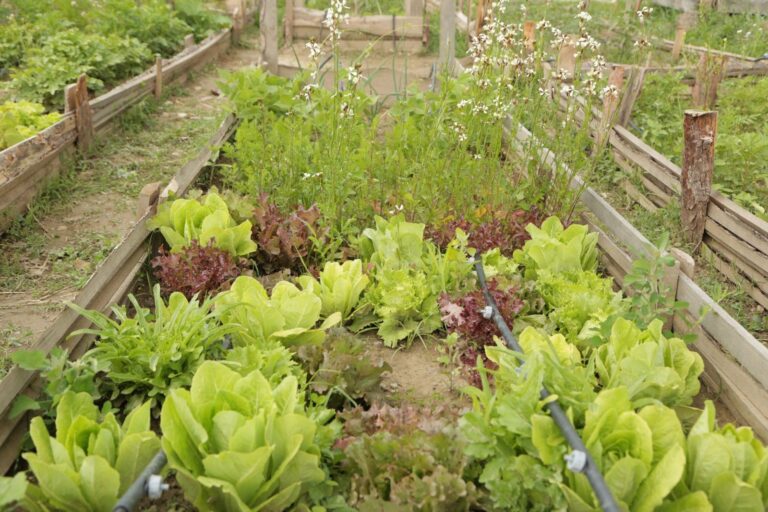
Photo: Rows of green and red lettuce growing in wooden-edged beds with drip irrigation. SA, The Green Ark, Bostanie, CC BY 4.0, via Wikimedia Commons
North Carolina pruning timing for trees, shrubs, roses and fruit
Filter by a plant name or a season.
Trees
| Plant | Timing as printed | What to cut, as printed | Source |
|---|---|---|---|
| Bleeding trees (birch, elm, maple) | Autumn (to avoid sap flow in late winter or spring) | Bleeding seldom harmful Avoid: Late winter or spring when sap flowing; late summer/early autumn limit pruning | General Pruning Techniques |
| Common crape myrtle (Plant Toolbox) Lagerstroemia indica | Late winter or spring before the new growth on which blossoms appear begins | Thin if required; severe pruning or topping should not be needed to control size Avoid: Topping | NC State Extension Plant Toolbox |
| Crape myrtle Lagerstroemia indica | Late winter to early spring, before new growth begins | Prune summer-flowering shrubs that flower on new growth; extensive pruning in late winter to early spring Avoid: Topping (inappropriate); heavy dormant-season pruning can cause cambium damage | 11. Woody Ornamentals |
| Crape myrtle (growth stimulated by dormant pruning) Lagerstroemia indica | Dormant season | Moderate to heavy dormant pruning stimulates new growth that light frost can damage Avoid: Moderate to heavy dormant pruning (new succulent stems not cold hardy) | General Pruning Techniques |
| Deciduous trees (decay fungi) | Late winter or early spring | Avoid: Autumn, when decay fungi are sporulating | General Pruning Techniques |
| Deciduous trees (older) | Late winter when dormant | Limbs not obscured by leaves Avoid: Birch, honey locust, maple, dogwood, elm, walnut bleed sap if pruned late winter or early spring | 11. Woody Ornamentals |
| Pines Pinus | Spring, when candle has extended to full length and needles are still soft | Remove about half the length of the candle | 11. Woody Ornamentals |
| Prunus (peach, plum, cherry, ornamental) and bacterial canker | Not in fall or early winter | Avoid: Do not prune plants in the genus Prunus in fall or early winter when bacterial cankers are reproducing | 11. Woody Ornamentals |
| Trees (summer limit) | Do little or no pruning after July 4th | Avoid: New growth may not mature before cold weather | 11. Woody Ornamentals |
Shrubs
| Plant | Timing as printed | What to cut, as printed | Source |
|---|---|---|---|
| Azalea and abelia (vigorous shoots) Rhododendron spp., Abelia spp. | Late winter or early spring for moderate to heavy pruning; rejuvenate after flowering in spring | Cut long vigorous shoots back severely within the canopy; leave a few leaves | 11. Woody Ornamentals |
| Azaleas, forsythia, quince, some spirea, many viburnums (one-year-old wood) | Directly after flowering | Bloom on one-year-old wood | General Pruning Techniques |
| Bigleaf hydrangea Hydrangea macrophylla | After flowering; any pruning before August 1 | Blooms on old wood Avoid: Pruning in the fall or spring could remove all the flower buds | 11. Woody Ornamentals |
| Bigleaf hydrangea (Plant Toolbox) Hydrangea macrophylla | Before August 1 | NC State Extension Plant Toolbox | |
| Broadleaf evergreens (general) | Early spring, can be done any time of year | Cut back damaged, diseased, dying, or dead branches | 11. Woody Ornamentals |
| Butterfly bush Buddleja davidii | Early spring | Prune to control growth and encourage large flower production; flowers on new growth | NC State Extension Plant Toolbox |
| Butterfly bush (Handbook figure caption) Buddleja davidii | Early spring (cut back to framework); late summer (remove faded blooms) | Prune back to a framework; deadhead to promote further flowering | 11. Woody Ornamentals |
| Early-spring-flowering broadleaf evergreens | Immediately after they finish flowering | Avoid: Do not prune in late summer, fall, or winter (reduces flowers) | 11. Woody Ornamentals |
| Forsythia Forsythia x intermedia | Immediately after spring flowering | Prune the oldest stems Avoid: If done after mid-July, you will likely remove flower buds for the following spring | NC State Extension Plant Toolbox |
| Hydrangeas (general) Hydrangea spp. | After flowering (listed under Fall) | Exception to the customary practice for shrubs that bloom in summer | 11. Woody Ornamentals |
| Lilac Syringa spp. | As soon as possible after flowers fade in spring | Spring-flowering shrub Avoid: Late summer, fall, winter, early spring | 11. Woody Ornamentals |
| Oakleaf hydrangea Hydrangea quercifolia | Immediately after flowering; winter-damaged stems in early spring | Blooms on old wood; prune if needed | NC State Extension Plant Toolbox |
| Overgrown broadleaf evergreens (holly, camellia, mountain laurel) Ilex, Camellia, Kalmia latifolia | Late winter or early spring just before new growth begins | Cut back to bare branches 2 feet to 4 feet from the ground; recover in two to three years | 11. Woody Ornamentals |
| Panicle hydrangea Hydrangea paniculata | Late winter or spring | Can be severely pruned because it blooms on new growth Avoid: Woody stems formed the previous year do not carry flowers | NC State Extension Plant Toolbox |
| Panicled hydrangea (new-wood bloomers) Hydrangea paniculata | Late winter or early spring (can be fall if fruit is not a key feature) | Category: blooms on new wood | General Pruning Techniques |
| Smooth hydrangea Hydrangea arborescens | Late winter | Can be pruned back close to the ground to encourage vigorous stem growth | NC State Extension Plant Toolbox |
| Spring-flowering shrubs (forsythia, deutzia, lilac, viburnum, mock orange, spiraea) Forsythia, Deutzia, Syringa, Viburnum, Pittosporum tobira, Spiraea | As soon as possible after flowers fade in spring | These shrubs flower on buds formed the previous summer or fall Avoid: If pruned during late summer, fall, winter, or early spring, many flower buds are removed | 11. Woody Ornamentals |
| Summer- and fall-flowering shrubs (abelia, beautyberry, rose of Sharon, summersweet) | Late winter or early spring, before new growth begins | They flower on new growth | 11. Woody Ornamentals |
| Witch hazel Hamamelis virginiana | Early spring | Pruning not usually necessary except to maintain shape Avoid: Flowers appear on old growth | NC State Extension Plant Toolbox |
Hedges and evergreens
| Plant | Timing as printed | What to cut, as printed | Source |
|---|---|---|---|
| Boxwood Buxus sempervirens | Late winter (rejuvenation); cut only the tips of stems | Pruned by cutting only the tips of stems; avoid severe pruning, spread heavy pruning over several years Avoid: Avoid severe pruning if possible as plants are slow to recover | 11. Woody Ornamentals |
| Boxwood and other foliage evergreens (hedge or topiary) Buxus | A number of times throughout the growing season, depending on growth rate | Maintain a hedge or topiary form | General Pruning Techniques |
| Formal hedges | Spring after the main flush of growth has fully elongated; shearings throughout the growing season | Shear to keep formal shape | 11. Woody Ornamentals |
| Informal hedges | Late winter to early spring before new growth; follow-up in midsummer | Pruned only one or two times per year; top narrower than base | 11. Woody Ornamentals |
| Narrowleaf evergreens (juniper, pine, cedar, spruce, yew) | Winter or early spring before new growth; second light pruning late June to early July | Thinning and heading; cut back to a lateral Avoid: Avoid cutting back to bare branches; heavy pruning kills most narrowleaf evergreens | 11. Woody Ornamentals |
Roses
| Plant | Timing as printed | What to cut, as printed | Source |
|---|---|---|---|
| Climbing roses Rosa | Winter (flowering laterals) | Shorten flowering laterals to three or four buds; remove old canes at the base after several years Avoid: Lady Banks and Mermaid rose: do not prune flowering laterals in winter | 11. Woody Ornamentals |
| Hybrid tea, floribunda, grandiflora, hybrid perpetual, polyantha roses Rosa | Early spring as the buds are swelling, before growth has started | Keep three to five strong canes, cut back to 18 to 24 inches | 11. Woody Ornamentals |
| Rambling roses (Rosa luciae-derived) Rosa | After flowering | Cut old canes to the ground | 11. Woody Ornamentals |
| Shrub or landscape roses Rosa | Fall or spring | Cut back to 6 inches to 10 inches above ground | 11. Woody Ornamentals |
| Spring-blooming shrub roses Rosa | After they have flowered | Remove old canes, dead wood and dead flowers | 11. Woody Ornamentals |
Vines
| Plant | Timing as printed | What to cut, as printed | Source |
|---|---|---|---|
| Bunch grape (cordon-and-spur / cane) Vitis | Annually; vine stores food over winter, buds reduced before spring growth | Prune every year; cane pruning for American bunch grapes | 14. Small Fruits |
| Clematis (new wood: jackmanii, tangutica, viticella) Clematis | Late winter to early spring | Severe pruning to promote new growth | 11. Woody Ornamentals |
| Clematis (one-year-old wood: armandii, montana) Clematis | Immediately after flowering | Cut away all flowering wood to within a few inches of the main framework | 11. Woody Ornamentals |
| Muscadine grape Vitis rotundifolia | Late February or early March | Prune canes to spurs with three to four buds; sap bleeding is normal | 14. Small Fruits |
| Vines (general) | After flowering for spring-flowering vines; dormant season for most others | 11. Woody Ornamentals | |
| Wisteria Wisteria spp. | Late summer and early fall before flower bud development | Reduce spur-bearing shoot length by one-half or greater Avoid: Never prune heavily during the dormant season | 11. Woody Ornamentals |
Fruit plants
| Plant | Timing as printed | What to cut, as printed | Source |
|---|---|---|---|
| Apple and pear (pome fruit) Malus, Pyrus | Dormant (late winter); see fruit tree dormant pruning | Fruit on spurs of wood at least two years old; avoid heading back all branches Avoid: Heading back all branches removes most fruiting wood | 15. Tree Fruit and Nuts |
| Black raspberry Rubus occidentalis | Summer pinch when new shoots reach 18 to 24 inches; spring prune laterals to 12 to 18 inches | 14. Small Fruits | |
| Blackberry (erect) Rubus | Late winter (laterals back to 12 to 18 inches); after harvest remove fruiting canes; tip new shoots in summer at 30 to 36 inches | Leave about six canes per plant | 14. Small Fruits |
| Blackberry (semi-trailing) Rubus | Spring of second season (laterals back to 12 to 18 inches); after harvest remove old fruiting canes | Thin new shoots to four to six per crown | 14. Small Fruits |
| Blueberry Vaccinium | Dormant (winter) season after leaves have fallen | Annual pruning; remove at least a third of flower buds Avoid: Avoid leaving stubs; do not treat pruning cuts | 14. Small Fruits |
| Fig (Plant Toolbox) Ficus carica | Each winter (light pruning) | Fruits form on new wood | NC State Extension Plant Toolbox |
| Fruit trees (dormant pruning) | Late winter | Prune latest-blooming trees first: apple and pecan, then cherry, peach, plum Avoid: Avoid early dormant pruning to avoid winter injury | 15. Tree Fruit and Nuts |
| Fruit trees (summer pruning) | As buds start to grow, generally after vegetative growth is several inches long; not after end of July | Limited to removing upright, vigorous current-season growth with thinning cuts Avoid: Do not summer prune after the end of July | 15. Tree Fruit and Nuts |
| Peach and plum (stone fruit) Prunus persica, Prunus domestica | Dormant (late winter) | Bear most fruit on one-year-old shoots; 12 to 18 inches of new growth is essential | 15. Tree Fruit and Nuts |
| Primocane-fruiting raspberry Rubus | Before new growth starts in spring | Cut the canes to within 2 inches of the ground | 14. Small Fruits |
| Red raspberry Rubus idaeus | Late February thin canes; after harvest remove fruiting canes | Thin to 4 to 6 inches apart; head canes back to about 5 feet Avoid: Do not pinch the tips of new shoots in summer | 14. Small Fruits |
Perennials and grasses
| Plant | Timing as printed | What to cut, as printed | Source |
|---|---|---|---|
| Maidengrass (ornamental grass) Miscanthus sinensis | Late winter or early spring, before or just as new blades begin to appear | Cut foliage down | NC State Extension Plant Toolbox |
| Perennials (division timing) | Spring when new shoots are 2 to 3 inches tall, or fall when foliage starts to die back | Division (not pruning); daylily and bearded iris after flowering even in summer | 10. Herbaceous Ornamentals |
Timing words are copied from the publication. Publications can disagree, so a plant can appear in more than one row. Blank cells mean the source prints nothing for that column.


North Carolina bulbs: tulips, daffodils, garlic, dahlias and more
| Plant | Action | Timing as printed | Depth or spacing as printed | Source |
|---|---|---|---|---|
| Bulbs (digging method) | Dig | Fall when the foliage turns yellow after a frost | 10. Herbaceous Ornamentals | |
| Bulbs (post-flower fertilizing) | Plant | Fertilize when foliage 1 to 2 inches tall | 10. Herbaceous Ornamentals | |
| Caladium | Dig | Fall all parts of the state | 10. Herbaceous Ornamentals | |
| Canna | Store | Fall harvest | 10. Herbaceous Ornamentals | |
| Daffodil | Divide | When flowering decreases from crowding; move after foliage has faded | 10. Herbaceous Ornamentals | |
| Daffodil (hardiness) | Plant | Fall | 10. Herbaceous Ornamentals | |
| Daffodil (moving) | Lift | After the foliage has faded | 10. Herbaceous Ornamentals | |
| Dahlia | Dig | Fall (dug in Piedmont and mountains; left in ground in eastern NC) Piedmont and mountain regions (dig); eastern part of NC (survive in ground) | 10. Herbaceous Ornamentals | |
| Garlic | Plant | Bulbs planted Sep 15 through Nov 15 half-month columns Central North Carolina | 4–6 inches between plants | Central North Carolina Planting Calendar for Annual Vegetables, Fruits, and |
| Garlic | Plant | Bulbs planted Sep 1 through Nov 1 half-month columns Western North Carolina | 4–6 inches between plants | Western North Carolina Planting Calendar for Annual Vegetables, Fruits, and |
| Garlic | Plant | Bulbs planted Sep 15 through Nov 15 half-month columns Eastern North Carolina | 4–6 inches between plants | Eastern North Carolina Planting Calendar for Annual Vegetables, Fruits, and |
| Gladiolus | Store | Harvest after the foliage dies back (G. byzantinus) | 10. Herbaceous Ornamentals | |
| Hyacinth | Plant | Fall | 10. Herbaceous Ornamentals | |
| Onion (bulb; sets) | Plant | B (bulbs) in Mar 1 and Mar 15 columns; S (seed) other columns Central North Carolina | 4 inches between plants | Central North Carolina Planting Calendar for Annual Vegetables, Fruits, and |
| Onion (bulb; sets) | Plant | B (bulbs) in Mar 1 and Mar 15 columns; S Feb 15 to Mar 15, Aug 1 and Aug 15 Western North Carolina | 4 inches between plants | Western North Carolina Planting Calendar for Annual Vegetables, Fruits, and |
| Onion (bulb; sets) | Plant | B (bulbs) in Mar 1 and Mar 15 columns Eastern North Carolina | 4 inches between plants | Eastern North Carolina Planting Calendar for Annual Vegetables, Fruits, and |
| Onion (harvest) | Dig | When the tops fall over and begin to turn yellow | 16. Vegetable Gardening | |
| Spring-flowering bulbs (alternate method) | Plant | Fall | Till 4 inches deep, set bulbs on surface, cover with 5 to 8 inches of screened pine bark mulch | 10. Herbaceous Ornamentals |
| Spring-flowering bulbs (general) | Plant | Fall; wait until soil temperature is below 60°F; October in Zone 6, November or early December in Zones 7 and 8 Zone 6; Zones 7 and 8 | 2½ to 3 times the bulb diameter; most small bulbs 5 inches deep, large bulbs 8 inches deep (mulch included) | 10. Herbaceous Ornamentals |
| Spring-flowering bulbs (planting depth) | Plant | Fall | Plant bulbs at a depth 2½ to 3 times as deep as the diameter of the bulb; small bulbs 5 inches deep, large bulbs 8 inches deep | 10. Herbaceous Ornamentals |
| Summer-flowering bulbs (dividing) | Divide | Spring just prior to planting or before new growth begins | 10. Herbaceous Ornamentals | |
| Tender bulbs (general) | Dig | Fall after frost; replant in spring | 10. Herbaceous Ornamentals | |
| Tulip | Plant | Fall (see spring-flowering bulbs) | 10. Herbaceous Ornamentals | |
| Tulip and hyacinth (non-flowering) | Plant | Replant new bulbs in the fall | 10. Herbaceous Ornamentals |
Planting, digging and storing times are copied from the publications. Some sources are older publications; the date printed on each is in the source list below.
North Carolina pruning and bulbs: questions
When is the right time to cut back crape myrtle in North Carolina?
North Carolina Extension Gardener Handbook, 2nd ed. (NC State Extension) prints: late winter to early spring, before new growth begins. Other rows in the table above may differ; the source for each is linked.
When do I cut back hydrangeas in North Carolina?
Bigleaf hydrangea: after flowering; any pruning before August 1. Source: North Carolina Extension Gardener Handbook, 2nd ed. (NC State Extension). Timing depends on the hydrangea type, so check each type in the table.
When do I cut back roses in North Carolina?
Hybrid tea, floribunda, grandiflora, hybrid perpetual, polyantha roses: early spring as the buds are swelling, before growth has started. Source: North Carolina Extension Gardener Handbook, 2nd ed. (NC State Extension).
When do I prune fruit trees in North Carolina?
Fruit trees (dormant pruning): late winter. Source: North Carolina Extension Gardener Handbook, 2nd ed. (NC State Extension). Other fruit rows are in the table above.
What month do you plant spring-flowering bulbs in North Carolina?
Spring-flowering bulbs (general), plant: fall; wait until soil temperature is below 60°F; October in Zone 6, November or early December in Zones 7 and 8 (Zone 6; Zones 7 and 8). Source: North Carolina Extension Gardener Handbook, 2nd ed. (NC State Extension).
When do you plant garlic in North Carolina?
Garlic, plant: bulbs planted Sep 15 through Nov 15 half-month columns (Central North Carolina). Source: NC State Extension.
Which sources does this North Carolina pruning page use?
Only N.C. Cooperative Extension and other official publications are used, listed with dates below. Nothing here comes from nurseries, news or blogs. Plants with no official timing found are left out, not filled in.

North Carolina pruning and bulb sources
- 16. Vegetable Gardening, North Carolina Extension Gardener Handbook, 2nd ed. (NC State Extension), AG-831. Date: Feb. 1, 2022. Read November 15, 2026.
- 10. Herbaceous Ornamentals, North Carolina Extension Gardener Handbook, 2nd ed. (NC State Extension), AG-831. Date: Feb. 1, 2022. Read November 15, 2026.
- 11. Woody Ornamentals, North Carolina Extension Gardener Handbook, 2nd ed. (NC State Extension), AG-831. Date: Feb. 1, 2022. Read November 15, 2026.
- 14. Small Fruits, North Carolina Extension Gardener Handbook, 2nd ed. (NC State Extension), AG-831. Date: Feb. 1, 2022. Read November 15, 2026.
- 15. Tree Fruit and Nuts, North Carolina Extension Gardener Handbook, 2nd ed. (NC State Extension), AG-831. Date: Feb. 1, 2022. Read November 15, 2026.
- General Pruning Techniques, NC State Extension, AG-780-03. Date: April 7, 2020 (Reviewed/Revised March 5, 2025). Read November 15, 2026.
- NC State Extension Plant Toolbox, NC State Extension. Date: not printed. Read November 15, 2026.
- Central North Carolina Planting Calendar for Annual Vegetables, Fruits, and, NC State Extension, AG-756-01. Date: July 8, 2016. Read November 15, 2026.
- Western North Carolina Planting Calendar for Annual Vegetables, Fruits, and, NC State Extension, AG-756-03. Date: Aug. 4, 2016. Read November 15, 2026.
- Eastern North Carolina Planting Calendar for Annual Vegetables, Fruits, and, NC State Extension, AG-756-02. Date: June 15, 2016. Read November 15, 2026.
Only extension services and other official agencies are used.
More for North Carolina: North Carolina gardening, what to plant now, frost dates and the planting calendar.
Photos: Rows of green and red lettuce growing in wooden-edged beds with drip irrigation: SA, The Green Ark, Bostanie, CC BY 4.0, via Wikimedia Commons; Fir-topped ridge above a sea of valley clouds, Buncombe County: jeffgunn, CC BY 2.0, via Flickr; Haw River rapids among bare winter trees, Jordan Game Land: pmuellr, CC BY 2.0, via Flickr; Jacob Fork pools among boulders and rhododendron, South Mountains: bobistraveling, CC BY 2.0, via Flickr; Neuse River between autumn trees, Wake County: James Willamor, CC BY-SA 2.0, via Flickr.