Home › North Carolina › Soil testing
North Carolina
North Carolina Soil Testing
Home soil samples in North Carolina go to the NCDA&CS Agronomic Services Division Soil Testing Lab, run by North Carolina Department of Agriculture and Consumer Services. The page below shows the fee as printed ($0.00 per sample, April 1, November 30 for Standard Analysis (non-peak season)) and the sampling steps from 8 official sources.
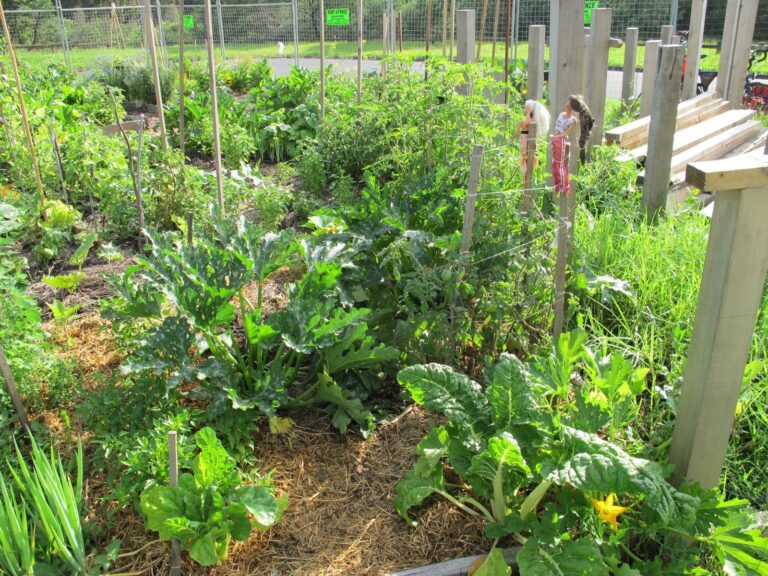
Photo: Community vegetable garden with chard, squash and staked tomato plants in summer. Gavin Anderson, CC BY-SA 2.0, via Wikimedia Commons
Soil test labs for North Carolina gardens and lawns
| Lab | Address | Drop-off as printed | Online as printed | Turnaround as printed | Source |
|---|---|---|---|---|---|
| NCDA&CS Agronomic Services Division Soil Testing Lab North Carolina Department of Agriculture and Consumer Services (NCDA&CS) | UPS or FedEx: 4300 Reedy Creek Rd, Raleigh, NC 27607; US Postal Service: 1040 Mail Service Center, Raleigh, NC 27699 | In person at the Agronomic Division loading dock Monday-Friday 7:00 a.m. to 4:00 p.m.; many NCSU county extension offices courier samples (varies by county); boxes available at county extension offices | Submit samples online (Preferred); print the form and include it with samples (PALS portal) | Agronomic Services, Submit Soil Samples |
Blank cells mean the source prints nothing for that column. Contact details can change; check the lab page before sending a sample.

Rock spire and wooded valleys from Grandfather Mountain, Avery County
North Carolina soil test fees as printed
| Lab | Test | Fee as printed | Includes as printed | For | Source |
|---|---|---|---|---|---|
| NCDA&CS Agronomic Services Division Soil Testing Lab | Standard Analysis (non-peak season) | $0.00 per sample, April 1, November 30 | Mehlich-3 extractable phosphorus, potassium, calcium, magnesium, sulfur, sodium, zinc, manganese, copper, humic matter, pH and Mehlich buffer pH, and weight per volume. CEC and base saturation … | All | Agronomic Services, Soil Tests and Fees |
| NCDA&CS Agronomic Services Division Soil Testing Lab | Standard Analysis (peak season) | $5.00 per sample, from December 1, 2026 (peak season through March 31, 2027) | All | Agronomic Services, Soil Tests and Fees | |
| NCDA&CS Agronomic Services Division Soil Testing Lab | Standard Analysis, peak season start | $5 per sample for samples arriving on or after Dec. 1, 2026 | All | Agronomic Services, Peak Soil Season 2026 | |
| NCDA&CS Agronomic Services Division Soil Testing Lab | Nematode Assay | $10 | All | Agronomic Services N.C. Grower Fees | |
| NCDA&CS Agronomic Services Division Soil Testing Lab | Pinewood Nematode Assay | $15 | All | Agronomic Services N.C. Grower Fees | |
| NCDA&CS Agronomic Services Division Soil Testing Lab | Soilless Media Analysis (potting soil, planting mixes) | $10 | All | Agronomic Services N.C. Grower Fees | |
| NCDA&CS Agronomic Services Division Soil Testing Lab | Expedited Service | $250 | All | Agronomic Services N.C. Grower Fees | |
| NCDA&CS Agronomic Services Division Soil Testing Lab | Heavy metals (regulatory only) | $30; not available to homeowners or community garden growers | All | Agronomic Services, Soil Tests and Fees |
Fees are copied from the source and can change. Older publications can print different prices, so a test can appear in more than one row; the source list below gives each date.
North Carolina soil sampling steps from extension
| Step | What the source says | Applies to | Source |
|---|---|---|---|
| How deep to sample | Established lawns 4 inches; vegetable gardens 6 to 8 inches; shrubs and trees 4 to 6 inches. | All | Agronomic Services, Collect Soil Samples |
| How many cores | Collect a slice or core of soil from 8 to 10 random locations across the lawn or garden. | All | Agronomic Services, Collect Soil Samples |
| Mixing the sample | Combine the soil cores in a clean plastic bucket, break up clumps, and mix thoroughly. | All | Agronomic Services, Collect Soil Samples |
| How much soil to send | Fill the official soil sample box to the red line with the mixed soil. | All | Agronomic Services, Collect Soil Samples |
| Container | Use official NCDA&CS soil boxes only. Do not use brass, bronze or galvanized tools (including buckets). Put soil directly in the box, not in a bag. | All | Agronomic Services, Collect Soil Samples |
| Container | Do not put soil in a bag inside the box; do not tape the box shut. | All | Agronomic Services, Collect Soil Samples |
| Labeling | Sample ID (up to 5 letters or numbers) must be on both the soil box and the submission form, and should reflect where the sample was collected. | All | Agronomic Services, Submit Soil Samples |
| When to sample | Do not collect soil when too wet: if too wet to till or plant, it is too wet to sample. | All | Agronomic Services, Collect Soil Samples |
| When to sample | Soil testing is free April 1, November 30, 2026; submitting before the fee season also gives faster turnaround (news release). | All | Submit soil samples by Nov. 30 to avoid peak-season fees |
| Other sampling steps | One sample is usually sufficient for each distinct area; use separate labeled samples for areas with different nutrient needs (FRONT, BACK, SIDE, BLUEB). | All | Agronomic Services, Collect Soil Samples |
| Other sampling steps | Diagnostic samples: collect from both the problem location and a healthy location for comparison; sample within the root zone. | All | Agronomic Services, Submit Soil Samples |
| Other sampling steps | A crop code is required on the submission form; recommendations are not provided without it. | All | Agronomic Services, Submit Soil Samples |
| Other sampling steps | Do not ship samples in paper envelopes or plastic bags; package boxes tightly in cardboard. | All | Agronomic Services, Submit Soil Samples |
| Other sampling steps | Soilless media such as potting soil or material with less than 50% native mineral soil is not soil; submit under Soilless Media Analysis. | All | Agronomic Services, Collect Soil Samples |
Publications can disagree on depth and the number of cores, so each is its own row. Follow the lab you send the sample to.
North Carolina soil test results and pH
| What the report or publication says | Source |
|---|---|
| Results are reported as an index showing whether nutrient levels are low, optimum, or excessive; soil pH and acidity are measured to determine lime needs. | Agronomic Services, Soil Testing |
| Homeowner fertilizer and lime recommendations are given in pounds per 1,000 square feet. | Agronomic Services, Soil Testing |
| Compare soil pH to the graph on the report showing the recommended range for your crop. When pH is lower than optimum, a lime rate is provided. | Agronomic Services, Understand Your Soil Report |
| Lime at the suggested rate raises pH into the optimal range for two to three years, depending on soil type; do not lime every year, base on a current test. | Agronomic Services, Understand Your Soil Report |
| Lime can be applied any time but works best several months before planting; for new plantings mix in to about 4 inches for lawns and 6 inches for vegetable gardens. | Agronomic Services, Understand Your Soil Report |
| If lime was applied in the past year and lime history was given, a lime recommendation may not be given even where pH is not optimum. | Agronomic Services, Understand Your Soil Report |
| Phosphorus Index (P-I) and Potassium Index (K-I): optimum range of 50-70 on the report graph. | Agronomic Services, Understand Your Soil Report |
| If P and K are already optimum (>50), only nitrogen is recommended: 1.0 lb N per 1,000 sq. ft., except centipede grass 0.5 lb. Nitrogen is not measured on the soil test. | Agronomic Services, Understand Your Soil Report |
| Mn, Zn, Cu and S indexes greater than 25 are likely sufficient; below 25 on a homeowner report, no fertilizer recommendation is given. | Agronomic Services, Understand Your Soil Report |
| CEC indicates how well soil holds positively charged nutrients; sandy soils tend to have low CECs (< 3.0). W/V is a texture indicator; HM% is humic matter. | Agronomic Services, Understand Your Soil Report |
| Reports are delivered by email and can be found in the PALS portal; reports are not released until paid in full. | Agronomic Services, Soil Tests and Fees |
| The Agronomic Division does not test soil for contaminants. | Agronomic Services, Soil Testing |
pH targets as printed
| Crop or use | Range as printed | Source |
|---|---|---|
| Azalea, rhododendron, camellia, mountain laurel | 5.0–5.5 | Agronomic Services, Understand Your Soil Report |
| Most shrubs and shade trees | 6.0 | Agronomic Services, Understand Your Soil Report |
| Fescue, bermudagrass, zoysia, St. Augustine grass | 6.0–6.5 | Agronomic Services, Understand Your Soil Report |
| Centipede grass | 5.5 | Agronomic Services, Understand Your Soil Report |
| Rose | 6.5 | Agronomic Services, Understand Your Soil Report |
| Berries and most fruit trees, except blueberries | 6.0–6.5 | Agronomic Services, Understand Your Soil Report |
| Most vegetable and field crops | 6.0–6.5 | Agronomic Services, Understand Your Soil Report |
| Tomato | 6.5 | Agronomic Services, Understand Your Soil Report |
Only what the sources print is shown. Where no pH target is printed for a crop, none is given here.
North Carolina soil testing: questions
How much does North Carolina charge to test garden soil?
Standard Analysis (non-peak season) at the NCDA&CS Agronomic Services Division Soil Testing Lab: $0.00 per sample, April 1, November 30, as printed by NCDA&CS Agronomic Services Division. Other tests and older prices are in the fee table above.
How deep do I dig for a soil sample in North Carolina?
Established lawns 4 inches; vegetable gardens 6 to 8 inches; shrubs and trees 4 to 6 inches. Source: NCDA&CS Agronomic Services Division. Other sources print different depths, as shown above.
Which sources does this North Carolina soil page use?
Only N.C. Cooperative Extension, state agency and other official pages are used, listed with dates below. Nothing here comes from private lab advertising, nurseries, news or blogs. Items no source prints are left out, not filled in.
North Carolina soil testing sources
- Agronomic Services, Soil Testing, NCDA&CS Agronomic Services Division. Date: no date printed. Read November 18, 2026.
- Agronomic Services, Collect Soil Samples, NCDA&CS Agronomic Services Division. Date: 2026-05-12. Read November 18, 2026.
- Agronomic Services, Submit Soil Samples, NCDA&CS Agronomic Services Division. Date: 2026-11-13. Read November 18, 2026.
- Agronomic Services, Soil Tests and Fees, NCDA&CS Agronomic Services Division. Date: 2026-05-12. Read November 18, 2026.
- Agronomic Services, Understand Your Soil Report, NCDA&CS Agronomic Services Division. Date: 2026-07-15. Read November 18, 2026.
- Agronomic Services, Peak Soil Season 2026, NCDA&CS Agronomic Services Division. Date: 2026-11-06. Read November 18, 2026.
- Submit soil samples by Nov. 30 to avoid peak-season fees, NCDA&CS. Date: 2026-09-16. Read November 18, 2026.
- Agronomic Services N.C. Grower Fees, NCDA&CS Agronomic Services Division. Date: Effective 2026-03-02. Read November 18, 2026.
Only extension services and other official agencies are used.
More for North Carolina: North Carolina gardening, lawn care calendar, what to plant now and planting zones.
Photos: Community vegetable garden with chard, squash and staked tomato plants in summer: Gavin Anderson, CC BY-SA 2.0, via Wikimedia Commons; Layered blue ridges in fall from the Blue Ridge Parkway, Jackson County: msprague, CC BY-SA 2.0, via Flickr; Rock spire and wooded valleys from Grandfather Mountain, Avery County: bobistraveling, CC BY 2.0, via Flickr.