Home › Georgia › Pruning and bulbs
Georgia
Georgia Pruning and Bulb Timing
This page lists 58 pruning timing entries and 26 bulb timing entries for Georgia from 14 official publications of UGA Cooperative Extension and other official sources. Each row shows the timing as the publication prints it, with its source.
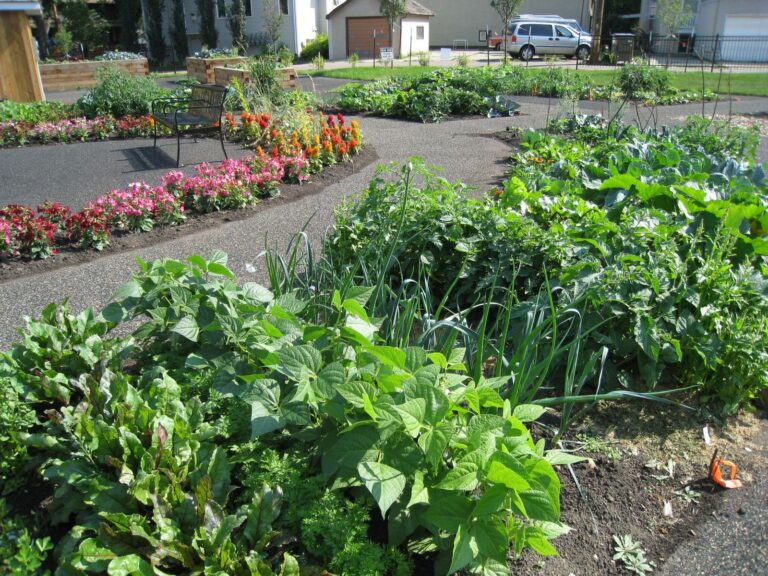
Photo: Community garden plots of beans, onions and greens beside flower borders and paths. Mack Male from Edmonton, AB, Canada, CC BY-SA 2.0, via Wikimedia Commons
Georgia pruning calendar from extension
The filter narrows the rows by plant or season.
Trees
| Plant | Timing as printed | What to cut, as printed | Source |
|---|---|---|---|
| Dogwood | Major cuts when dormant; otherwise after flowering | Sets blossom buds in late summer. Avoid: Pruning when dormant may sacrifice some blossoms. | Care of Ornamental Plants in the Landscape |
| Maple | Late winter for major cuts; light pruning in mid-summer | Prune in late winter if major cuts are necessary. Avoid: Avoid early spring pruning because sap will flow from the wounds. | Care of Ornamental Plants in the Landscape |
| Oak | When dormant | Prune to desired shape. | Care of Ornamental Plants in the Landscape |
| Pine, spruce, fir (needle evergreens) | Spring, at the candle stage of new growth | Remove all or part of new growth (candles); avoid pruning into old wood. Avoid: Avoid cutting back into hardened older wood. | Care of Ornamental Plants in the Landscape |
| Trees that bleed (maple, birch, dogwood, beech, elm, willow, flowering plum and cherry) | After the leaves have matured | Sap is not harmful but unsightly. | Pruning Ornamental Plants in the Landscape |
Shrubs
| Plant | Timing as printed | What to cut, as printed | Source |
|---|---|---|---|
| Azalea | After they bloom | Light pruning after bloom encourages branching and more flower buds next year. Avoid: Pruning after mid-July reduces spring flower display. | Pruning Ornamental Plants in the Landscape |
| Azalea (old overgrown plants) Rhododendron | February | Renew by cutting back close to ground level; otherwise thin after bloom if necessary. | Care of Ornamental Plants in the Landscape |
| Azalea (southern indica, severe pruning) | Just prior to the spring growing season south Georgia (southern Georgia indica cultivars) | Severe pruning to reduce size. Avoid: If pruning severely, do so before the plant flowers. | Pruning Ornamental Plants in the Landscape |
| Bigleaf hydrangea Hydrangea macrophylla | When the flowers begin to fade | Prune out flower heads and head back other shoots to encourage branching and fullness. Avoid: Flower buds form in late summer; avoid pruning after August 1; pruning in late summer, fall and winter removes potential flowers. | Growing Bigleaf Hydrangea |
| Broadleaf shrubs, severe pruning (azaleas, camellias, ligustrum, glossy abelia, nandina, cleyera, crepe myrtle) | When spring growth begins: mid-March in north Georgia and mid-February in south Georgia north Georgia; south Georgia | Cut back to within 12 inches of ground level when shrub overgrows its site. Avoid: Avoid pruning severely from late fall to mid-winter. | Care of Ornamental Plants in the Landscape |
| Camellia (Camellia japonica and sasanqua) Camellia | Fall and winter bloomers in early March; spring bloomers just after they bloom | Japonica needs little pruning; sasanqua may need considerable pruning, thin rather than shear. | Pruning Ornamental Plants in the Landscape |
| Chaste tree (vitex) | Before spring growth begins (listed under "Prune before spring growth begins") | Care of Ornamental Plants in the Landscape | |
| Crape myrtle | Late winter or early spring | Summer-flowering; can be pruned to tree form by selective thinning or to a shrub within a foot of ground level. Avoid: Not stated beyond summer-flowering note | Pruning Ornamental Plants in the Landscape |
| Crape myrtle Lagerstroemia indica | Dormant season (later winter to early spring) before growth resumes | Flowers on new growth; limited or no pruning gives the most natural trees. If pruning: remove suckers, lower branches in bottom third, crowded or crossing branches. Avoid: Avoid pruning in early fall before the first frost; it forces new growth and keeps the plant from going dormant. | Crape Myrtle Culture |
| Crape myrtle | When dormant ("Prune before spring growth begins" list) | Make thinning and heading cuts to produce a desired form; shrub form pruned close to ground, tree form keeps one to three trunks. | Care of Ornamental Plants in the Landscape |
| Crape myrtle second bloom (remove seed clusters) | After the flowers fade (second flush in late summer) | Remove seed clusters after flowers fade and thin some new growth to encourage a second flush. | Pruning Ornamental Plants in the Landscape |
| Forsythia Forsythia | After they bloom | Spring-flowering, pruned after bloom. Avoid: Pruning spring-flowering shrubs during the dormant season removes flower buds formed the previous fall. | Basic Principles of Pruning Woody Plants |
| Hydrangea (bigleaf, French, oakleaf) Hydrangea | After flowering | Flower buds form on old wood. | Care of Ornamental Plants in the Landscape |
| Hydrangea (panicle, smooth) Hydrangea | When dormant; remove spent blossoms after flowering | Blooms form on new wood. | Care of Ornamental Plants in the Landscape |
| Lilac | After flowering (listed under "Prune after flowering") | Care of Ornamental Plants in the Landscape | |
| Mockorange | After flowering | Thin out old wood; may be cut back to ground level if desired. | Care of Ornamental Plants in the Landscape |
| Nandina and Chinese mahonia | After the Christmas season (late winter or after fruiting per B1065) | Thin older canes to 6 to 8 inches of ground level; old plants can be cut to ground. | Pruning Ornamental Plants in the Landscape |
| Oakleaf hydrangea | After they bloom | Summer-flowering but forms flower buds the previous season, an exception to the pre-spring rule. | Pruning Ornamental Plants in the Landscape |
| Overgrown broadleaf shrubs, renewal pruning (azalea, camellia, ligustrum, abelia, nandina, cleyera, crape myrtle) | When spring growth begins: mid-March in north Georgia and mid-February in south Georgia north Georgia; south Georgia | Cut plants back 6 to 12 inches above ground level. Avoid: Pruning in late fall or mid-winter may encourage new growth that can be injured by cold. | Pruning Ornamental Plants in the Landscape |
| Pyracantha Pyracantha | After blooming; light periodic pruning in summer | Waiting avoids removing berry clusters; summer pruning encourages branching. | Pruning Ornamental Plants in the Landscape |
| Rose-of-Sharon (althea) | Late winter | Flowers on new growth. | Care of Ornamental Plants in the Landscape |
| Spirea | After bloom | Thin; most species respond well to severe pruning. | Care of Ornamental Plants in the Landscape |
| Spring-flowering shrubs (azalea, dogwood, forsythia, redbud, rhododendron) | After they bloom (plants that flower before May) | Flower buds set in fall. Avoid: Pruning during the fall or winter months eliminates or decreases their spring flower display. | Pruning Ornamental Plants in the Landscape |
| Tree-form shrubs (crape myrtle, yaupon holly, wax myrtle, wax-leaf ligustrum) | Early March before spring growth begins | Select one to three vigorous branches, prune others to ground level, remove laterals under 4 feet. | Pruning Ornamental Plants in the Landscape |
Hedges and evergreens
| Plant | Timing as printed | What to cut, as printed | Source |
|---|---|---|---|
| Boxwood | Almost any time of the year (thinning or shearing) | Prune by thinning or shearing; heavy pruning is slow to recover. Avoid: Avoid heavy pruning; boxwoods recover slowly and may even die when severely pruned. | Care of Ornamental Plants in the Landscape |
| Hedges (formal) | Sometimes three to five times during the growing season | Frequent shearing; pyramidal shape, narrowest at top. | Pruning Ornamental Plants in the Landscape |
Roses
| Plant | Timing as printed | What to cut, as printed | Source |
|---|---|---|---|
| Climbing roses | After the first flush of bloom in spring | Prune old canes to ground, leave five or six healthiest canes. | Pruning Ornamental Plants in the Landscape |
| Climbing roses | After the first flush of blooms fade | Prune back about one-third of total length and remove weak or damaged canes. | Roses in Georgia: Selecting and Growing Techniques |
| Roses (hybrid tea and grandiflora) | When the buds begin to swell: about mid-February in southern Georgia, mid-March in northern Georgia southern Georgia; northern Georgia | Remove dead or damaged canes, keep three to five healthy canes cut to within 15 to 18 inches of ground level. | Pruning Ornamental Plants in the Landscape |
| Roses (hybrid tea, grandiflora, floribunda) | Late winter before growth begins | Prune weak cultivars lightly and vigorous ones more heavily; remove weak or wounded canes and shoots below the graft union. | Roses in Georgia: Selecting and Growing Techniques |
| Roses (hybrid tea, grandiflora, floribunda) | Early spring when new growth begins | Care of Ornamental Plants in the Landscape |
Vines
| Plant | Timing as printed | What to cut, as printed | Source |
|---|---|---|---|
| Grape (bunch types) | Dormant season; February | Heavy annual pruning; cane or spur pruning. Bleeding does not damage the plant. | Home Fruit Orchard Pruning Techniques |
| Muscadine | February or early March | Cut back last year canes leaving about 3 in. of growth to form spurs. | Home Fruit Orchard Pruning Techniques |
| Muscadine Vitis rotundifolia | Between December and March (dormancy) | Spurs hold no more than five buds; 30 to 35 buds per foot of cordon for Carlos, 20 to 25 for Supreme. | Muscadine Grape Management |
| Vines (flowering) | Summer-blooming before new growth begins; spring-blooming after they flower | Examples: star jasmine, trumpetcreeper (summer); wisteria, Japanese honeysuckle (spring). | Pruning Ornamental Plants in the Landscape |
Fruit plants
| Plant | Timing as printed | What to cut, as printed | Source |
|---|---|---|---|
| Apple | At planting, then dormant pruning (late winter or early spring) | Head unbranched whip to 24 to 30 inches; train central leader with four or five scaffolds. | Home Fruit Orchard Pruning Techniques |
| Blackberry (trailing) | After the fruiting season; during the following winter | Remove old dying canes, tie new canes to trellis, tip 6 in. above top wire. | Home Fruit Orchard Pruning Techniques |
| Blueberry (rabbiteye) | Each winter (after establishment) | Cane renewal: remove one to three of the largest canes at 0 to 24 in. from ground, about 20% of canopy. | Home Fruit Orchard Pruning Techniques |
| Fig | Late during the winter after the first growing season; head back each spring after danger of frost but before growth starts | Bush form: select three to eight leaders; remove one-third to one-half of last year growth; remove dead wood and suckers. Avoid: Tree form is not practical for the Piedmont area of Georgia; figs there are frequently frozen back to the ground. | Home Fruit Orchard Pruning Techniques |
| Fig | Each spring beginning the second year, after danger of frost is past but before growth has started Piedmont (tree form impractical) | Remove about one-third to one-half the length of last year growth. | Home Garden Figs |
| Fruit trees (dormant pruning) | Late winter or early spring (dormant); summer pruning from early bud growth to end of July | Dormant pruning invigorates and encourages water sprouts; summer pruning is devigorating. Avoid: Pruning into late summer and early fall can increase potential for winter injury. | Home Fruit Orchard Pruning Techniques |
| Peach | Early spring, after danger of frost is over but when trees are still dormant | Open center (vase) or perpendicular V training. | Home Fruit Orchard Pruning Techniques |
| Peach | Not October through January | Avoid: Peach trees should not be pruned from October through January. | Basic Principles of Pruning Woody Plants |
| Peach (perpendicular V system) | February in year two; mid-summer, mid-May, and July or August water sprout removal | Remove non-fruiting wood in February; remove water sprouts and vertical shoots in season. | Home Fruit Orchard Pruning Techniques |
| Pear | At planting, then dormant pruning | Prune to single whip 24 to 30 inches; central leader; remove fire blight limbs as soon as they appear, cutting at least 6 in. below infection. | Home Fruit Orchard Pruning Techniques |
| Plum Prunus | Immediately after planting; summer of years two and three | Prune to 18 to 24 inches after planting; open vase with four scaffolds; remove center branches in summer. | Home Garden Plums |
| Raspberry (Dormanred) | Late February (tie to trellis); late winter (train new canes) | Canes lie on mulch until late February; after fruiting, prune out dead canes. | Home Fruit Orchard Pruning Techniques |
Perennials and grasses
| Plant | Timing as printed | What to cut, as printed | Source |
|---|---|---|---|
| Ground covers (English ivy, pachysandra, liriope, mondo grass, etc.) | Before spring growth begins: late January in south Georgia and by mid-February in north Georgia south Georgia; north Georgia | Mow off foliage at highest cutting height to rejuvenate after a harsh winter; do not injure crown. | Pruning Ornamental Plants in the Landscape |
| Herbaceous perennials (division) | Spring-flowering perennials in the fall; fall-flowering perennials in the spring | Division rule of thumb; beds renovated every 3 years (printed). Not a cutback timing. | Landscape Basics: Success with Herbaceous Perennials |
| Liriope Liriope | Four to six weeks before the spring growing season | Remove old foliage; a lawn mower at the highest setting works on level ground. | Care of Ornamental Plants in the Landscape |
| Ornamental grasses (e.g., pampas grass) | Late winter | Shearing removes old growth and makes way for new shoots. | Care of Ornamental Plants in the Landscape |
Other plants
| Plant | Timing as printed | What to cut, as printed | Source |
|---|---|---|---|
| Woody ornamentals (general) | Summer-flowering during the dormant winter season; spring-flowering after they bloom | Dormant winter pruning before spring growth for plants not grown for flowers. Avoid: Avoid heavy pruning during the late summer and fall because regrowth may occur and make the plants more susceptible to cold injury. | Basic Principles of Pruning Woody Plants |
| Woody plants not grown for flowers | Late winter, spring or summer months | Avoid: Avoid pruning during the fall or early winter; it may encourage tender new growth. | Pruning Ornamental Plants in the Landscape |
Timing words are copied from the publication. Publications can disagree, so a plant can appear in more than one row. Blank cells mean the source prints nothing for that column.

The Tallapoosa River flowing through green woods in Haralson County
Georgia bulb planting and digging times
| Plant | Action | Timing as printed | Depth or spacing as printed | Source |
|---|---|---|---|---|
| Allium (giant onion) | Plant | Fall (planting time F in table) | 4″ deep; spacing 6-18″ | Flowering Bulbs for Georgia Gardens |
| Bulbs (dividing and digging) | Divide | When foliage has turned yellow and withers; some need dividing every 2 to 3 years | Flowering Bulbs for Georgia Gardens | |
| Caladium | Dig | Dug and stored over winter | Flowering Bulbs for Georgia Gardens | |
| Caladium | Plant | Spring (planting time S in table); may be presprouted indoors | 1″ deep; spacing 12″ | Flowering Bulbs for Georgia Gardens |
| Canna | Lift | Lift and store during winter at 45–50 °F in Zone 7; rhizomes generally hardy in Zones 8 and 9 Zone 7; Zones 8-9 | Flowering Bulbs for Georgia Gardens | |
| Canna | Plant | Spring (planting time S in table) | 4″ deep; spacing 15-18″ | Flowering Bulbs for Georgia Gardens |
| Colchicum (autumn crocus) | Plant | Immediately upon receipt | 4″ deep; spacing 8″ | Flowering Bulbs for Georgia Gardens |
| Crocus | Plant | Fall (planting time F in table) | 2″ deep; spacing 2-3″ | Flowering Bulbs for Georgia Gardens |
| Daffodil / narcissus | Plant | Fall (planting time F in table) | 3-6″ deep; spacing 3-6″ | Flowering Bulbs for Georgia Gardens |
| Dahlia (dig) | Dig | After the first frost | Dahlias | |
| Dahlia (divide) | Divide | Each year; many growers wait until early spring when buds have swollen | Dahlias | |
| Dahlia (plant tubers) | Plant | Often April in south Georgia and May in the northern half of the state; June plantings often give the most perfect fall flowers south Georgia; northern half of Georgia | Tubers usually placed 4 to 6 in. deep; at least 3 to 4 ft apart | Dahlias |
| Dahlia (store) | Store | Let dug tubers dry a day; store at 35 °F to 50 °F | Dahlias | |
| Forcing bulbs (crocus, hyacinth, narcissus, daffodil, tulip, etc.) | Force | Pot in October or November; 8 to 12 weeks of darkness at about 40 °F | Flowering Bulbs for Georgia Gardens | |
| Garlic and elephant garlic | Plant | Fall, September to November; earlier maturing varieties can be planted later (November) South Georgia (publication scope) | Base 1 to 2 in. below surface; in-row 2 to 3 in. (regular), 3 to 4 in. (elephant); rows 12 to 18 in. | Production and Management of Garlic, Elephant Garlic, and Leek |
| Gladiolus | Lift | Corms not reliably winter hardy in Zone 7; lift and store at 35–40 °F Zone 7 | Flowering Bulbs for Georgia Gardens | |
| Gladiolus | Plant | Spring (planting time S in table); make successive plantings | 3-6″ deep; spacing 6″ | Flowering Bulbs for Georgia Gardens |
| Hyacinth | Plant | Fall (planting time F in table) | 4″ deep; spacing 5″ | Flowering Bulbs for Georgia Gardens |
| Hymenocallis (Peruvian daffodil) | Lift | Not reliably winter hardy outside Zone 9; lift and store at 65–70 °F outside Zone 9 | Flowering Bulbs for Georgia Gardens | |
| Lily | Plant | Early spring or fall (table: early S or F) | 4-6″ deep; spacing 9-18″ | Flowering Bulbs for Georgia Gardens |
| Lily-of-the-valley (divide) | Divide | In the fall, when foliage has developed fully and begun to yellow | Flowering Bulbs for Georgia Gardens | |
| Spring-flowering bulbs (general) | Plant | Fall; October through late December in most areas Georgia (most areas) | Two to three times the greatest diameter for bulbs 2 in. or more; three to four times for smaller bulbs | Flowering Bulbs for Georgia Gardens |
| Spring-flowering bulbs (precooling) | Store | Before planting, 12–16 week cold period at 40–50 °F areas with extremely mild winters | Flowering Bulbs for Georgia Gardens | |
| Summer-flowering bulbs (general) | Plant | Spring after the danger of frost has passed | Flowering Bulbs for Georgia Gardens | |
| Tender bulbs (general) | Dig | Dug in early fall and stored over winter for replanting the following spring | Flowering Bulbs for Georgia Gardens | |
| Tulip | Plant | Fall (planting time F in table) | 4-6″ deep; spacing 4-6″ | Flowering Bulbs for Georgia Gardens |
Planting, digging and storing times are copied from the publications. Some sources are older publications; the date printed on each is in the source list below.
Georgia pruning and bulbs: questions
What month do you prune crape myrtle in Georgia?
University of Georgia Cooperative Extension prints: late winter or early spring. Other rows in the table above may differ; the source for each is linked.
What month do you prune hydrangea in Georgia?
Bigleaf hydrangea: when the flowers begin to fade. Source: University of Georgia Cooperative Extension. Timing depends on the hydrangea type, so check each type in the table.
What month do you prune roses in Georgia?
Roses (hybrid tea and grandiflora): when the buds begin to swell: about mid-February in southern Georgia, mid-March in northern Georgia. Source: University of Georgia Cooperative Extension.
What is the pruning time for apple and peach trees in Georgia?
Trees that bleed (maple, birch, dogwood, beech, elm, willow, flowering plum and cherry): after the leaves have matured. Source: University of Georgia Cooperative Extension. Other fruit rows are in the table above.
When do you plant tulips and daffodils in Georgia?
Spring-flowering bulbs (general), plant: fall; October through late December in most areas (Georgia (most areas)). Source: University of Georgia Cooperative Extension.
What month is garlic planted in Georgia?
Garlic and elephant garlic, plant: fall, September to November; earlier maturing varieties can be planted later (November) (South Georgia (publication scope)). Source: University of Georgia Cooperative Extension.
Who publishes the Georgia pruning and bulb information?
Only UGA Cooperative Extension and other official publications are used, listed with dates below. Nothing here comes from nurseries, news or blogs. Plants with no official timing found are left out, not filled in.
Where the Georgia pruning facts come from
- Pruning Ornamental Plants in the Landscape, University of Georgia Cooperative Extension, B961. Date: April 9, 2024. Read November 15, 2026.
- Care of Ornamental Plants in the Landscape, University of Georgia Cooperative Extension, B1065. Date: October 10, 2022. Read November 15, 2026.
- Basic Principles of Pruning Woody Plants, University of Georgia Cooperative Extension, B949. Date: February 9, 2026. Read November 15, 2026.
- Crape Myrtle Culture, University of Georgia Cooperative Extension, C944. Date: June 15, 2026. Read November 15, 2026.
- Growing Bigleaf Hydrangea, University of Georgia Cooperative Extension, C973. Date: August 7, 2017. Read November 15, 2026.
- Roses in Georgia: Selecting and Growing Techniques, University of Georgia Cooperative Extension, C1001. Date: July 21, 2026. Read November 15, 2026.
- Home Fruit Orchard Pruning Techniques, University of Georgia Cooperative Extension, C1087. Date: June 9, 2020. Read November 15, 2026.
- Home Garden Plums, University of Georgia Cooperative Extension, B1518. Date: May 7, 2026. Read November 15, 2026.
- Home Garden Figs, University of Georgia Cooperative Extension, C945. Date: April 19, 2023. Read November 15, 2026.
- Muscadine Grape Management, University of Georgia Cooperative Extension, C1303. Date: February 21, 2024. Read November 15, 2026.
- Landscape Basics: Success with Herbaceous Perennials, University of Georgia Cooperative Extension, B1424. Date: May 19, 2022. Read November 15, 2026.
- Flowering Bulbs for Georgia Gardens, University of Georgia Cooperative Extension, B918. Date: April 9, 2024. Read November 15, 2026.
- Dahlias, University of Georgia Cooperative Extension, C576. Date: December 16, 2022. Read November 15, 2026.
- Production and Management of Garlic, Elephant Garlic, and Leek, University of Georgia Cooperative Extension, C852. Date: August 26, 2026. Read November 15, 2026.
Only extension services and other official agencies are used.
More for Georgia: Georgia gardening, what to plant now, frost dates and the planting calendar.
Photos: Community garden plots of beans, onions and greens beside flower borders and paths: Mack Male from Edmonton, AB, Canada, CC BY-SA 2.0, via Wikimedia Commons; Sunset glow over the valley from the rock overlook at Dowdell Knob in F.D. Roosevelt State Park: Dsdugan, CC0 1.0, via Wikimedia Commons; The Tallapoosa River flowing through green woods in Haralson County: John Phelan, CC BY 4.0, via Wikimedia Commons.