Home › Pennsylvania › Soil testing
Pennsylvania
Pennsylvania Soil Testing
Home soil samples in Pennsylvania go to the Penn State Agricultural Analytical Services Laboratory, run by Penn State College of Agricultural Sciences / Penn State Extension. The page below shows the fee as printed ($10.00 for Standard Individual Soil Test Kit) and the sampling steps from 10 official sources.
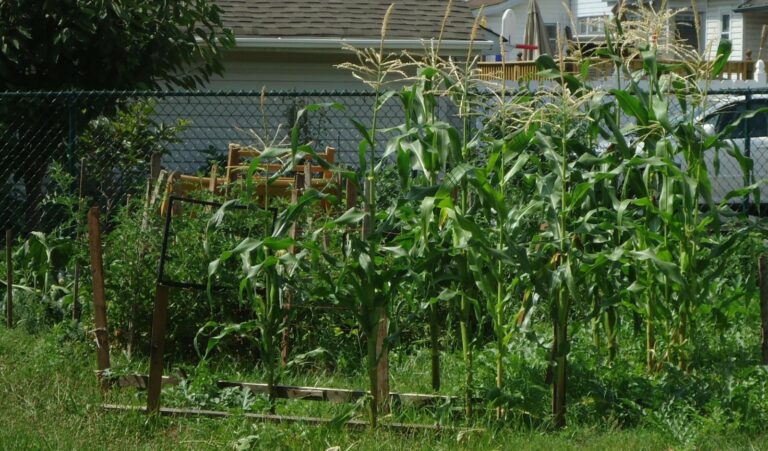
Photo: Tall corn and other vegetables growing in a fenced backyard garden. Tomwsulcer, CC0, via Wikimedia Commons
Pennsylvania soil lab, address and submission
| Lab | Address | Drop-off as printed | Online as printed | Turnaround as printed | Source |
|---|---|---|---|---|---|
| Penn State Agricultural Analytical Services Laboratory Penn State College of Agricultural Sciences / Penn State Extension | The Pennsylvania State University, 720 Tower Rd., University Park, PA 16802 | Soil Fertility Submission Forms |
Blank cells mean the source prints nothing for that column. Contact details can change; check the lab page before sending a sample.


Pennsylvania soil test packages and prices
| Lab | Test | Fee as printed | Includes as printed | For | Source |
|---|---|---|---|---|---|
| Penn State Agricultural Analytical Services Laboratory | Standard Individual Soil Test Kit | $10.00 | PH, Mehlich buffer lime requirement, P, K, Mg, Ca (Mehlich 3 ICP) with lime and fertilizer recommendations | All | Soil Fertility Testing |
| Penn State Agricultural Analytical Services Laboratory | Standard Multiple Soil Test Kit (volume discounts available) | $10.00 per sample | Same as standard fertility analysis; forms hold up to 10 samples per page | All | Soil Fertility Testing |
| Penn State Agricultural Analytical Services Laboratory | Soil fertility sample submitted on form, home garden/landscape/woodlot/Christmas trees | $10.00 per sample; checks payable to Penn State University | Home garden | Soil Fertility Submission Forms | |
| Penn State Agricultural Analytical Services Laboratory | Sample Prep (samples not submitted for fertility analysis) | $2.00 | All | Soil Fertility Testing | |
| Penn State Agricultural Analytical Services Laboratory | Organic Matter | $5.00 | All | Soil Fertility Testing | |
| Penn State Agricultural Analytical Services Laboratory | Soluble Salts | $5.00 | All | Soil Fertility Testing | |
| Penn State Agricultural Analytical Services Laboratory | Nitrate Nitrogen | $8.00 | All | Soil Fertility Testing | |
| Penn State Agricultural Analytical Services Laboratory | Ammonium Nitrogen | $12.00 | All | Soil Fertility Testing | |
| Penn State Agricultural Analytical Services Laboratory | Total Nitrogen (combustion) | $15.00 | All | Soil Fertility Testing | |
| Penn State Agricultural Analytical Services Laboratory | Total Carbon | $15.00 | All | Soil Fertility Testing | |
| Penn State Agricultural Analytical Services Laboratory | Hardcopy report (postage & handling) | $2.00 | All | Soil Fertility Testing | |
| Penn State Agricultural Analytical Services Laboratory | Additional fertility recommendations and report | $2.00 each | All | Soil Fertility Testing | |
| Penn State Agricultural Analytical Services Laboratory | Lead (EPA Method 3050B + 6010), individual analysis, results only | $30.00 | No interpretations or recommendations | All | Environmental Soil Testing |
| Penn State Agricultural Analytical Services Laboratory | Total Sorbed Metals Test | $90.00 | Cadmium, copper, lead, nickel, chromium and zinc (EPA 3050B + 6010) | All | Environmental Soil Testing |
| Penn State Agricultural Analytical Services Laboratory | Compost Test 1A | $45.00 | Percent solids, organic matter, pH, soluble salts, total N, total C, C:N ratio (about 1 quart) | All | Compost Testing |
| Penn State Agricultural Analytical Services Laboratory | Compost Test 1B | $60.00 | Test 1A plus ammonium nitrogen, phosphorus and potassium | All | Compost Testing |
Fees are copied from the source and can change. Older publications can print different prices, so a test can appear in more than one row; the source list below gives each date.
Pennsylvania soil sample instructions
| Step | What the source says | Applies to | Source |
|---|---|---|---|
| How deep to sample | Extension: 4 inches deep for lawns, 6 to 8 inches for gardens. | All | Soil Testing |
| How deep to sample | Lab instructions: sample to plow depth in cultivated land or to a depth of 6 inches (conflicts with extension 6 to 8 inches for gardens). | Garden | Soil Sampling Instructions |
| How deep to sample | Lab turf depth is 2 to 3 inches. | Lawn | Soil Sampling Instructions |
| How many cores | Extension: 8 to 10 random locations across the lawn or garden, mixed in a plastic bucket. | All | Soil Testing |
| How many cores | Lab instructions for agronomic, vegetables, small fruit and home garden crops: slices from at least 13 places in the area. | Garden | Soil Sampling Instructions |
| How many cores | Lab turf instructions: 12 or more locations, sample 2 to 3 inches deep (conflicts with extension 4 inches for lawns); discard grass and thatch. | Lawn | Soil Sampling Instructions |
| How many cores | Tree fruit: 8-inch deep cores just inside the canopy drip line from at least 15 to 20 locations. | Trees | Soil Sampling Instructions |
| Mixing the sample | Mix into one composite; air dry overnight on newspaper in a warm room; do not heat. | All | Soil Sampling Instructions |
| How much soil to send | Send 1 cup of representative sample in a padded mailer or small box, weighed as a parcel not a letter. | All | Soil Sampling Instructions |
| How much soil to send | Without a kit, submit approximately 1 cup in your own container such as a Ziploc bag. | All | Soil Fertility Submission Forms |
| How much soil to send | Extension video: after drying, place about one to two cups of mixed soil in a bag or container. | All | How to Take a Soil Sample |
| Container | Extension video: use a clean plastic bucket, not metal, which can contaminate the sample. | All | How to Take a Soil Sample |
| Labeling | Fill the provided bag with the mixture and label which area it came from. | All | Soil Testing |
| When to sample | How often: sandy soils every 2 to 3 years, clay soils every 3 to 4 years. No best season printed. | All | Soil Testing |
| Other sampling steps | Turf: do not contaminate soil with fertilizer; separate kits for maintenance vs new-turf recommendations. | Lawn | Soil Sampling Instructions |
| Other sampling steps | Lead sampling: upper 1-2 inches undisturbed, about 6 inches in gardens; 8-12 subsamples per area; about one cup air-dried. | Garden | Lead in Residential Soils: Sources, Testing, and Reducing Exposure |
| Other sampling steps | Lab asks that you not contact it about results unless long overdue, and recommends tracking for mailed samples. | All | Soil Fertility Testing |
Publications can disagree on depth and the number of cores, so each is its own row. Follow the lab you send the sample to.
Pennsylvania soil report ratings and lime advice
| What the report or publication says | Source |
|---|---|
| Each sample gets water pH, Mehlich buffer lime requirement, and P, K, Mg, Ca by Mehlich 3 (ICP). | Soil Testing |
| Report includes analysis plus lime and fertilizer recommendations for the specified crop. | Soil Fertility Testing |
| Rating scale: below optimum, optimum, above optimum; above optimum is not better. | Reading a Soil Test Report |
| Section three gives limestone, magnesium and gypsum recommendations, possibly even when levels are optimum. | Reading a Soil Test Report |
| Fertilizer recommendations are given in pounds per 100 square feet. | Reading a Soil Test Report |
| Nitrogen is not measured in the standard report; recommendation is based on the plants grown. | Reading a Soil Test Report |
| Soil test also measures pH, humic (organic) matter and exchangeable acidity. | Soil Testing |
| Agronomic crops also get Mehlich 3 zinc, copper and sulfur. | Soil Fertility Testing |
pH targets as printed
| Crop or use | Range as printed | Source |
|---|---|---|
| Grapes | between 5.6 and 6.4 | Home Gardening Soil Management |
| Stone fruits | between 6.0 and 6.5 | Home Gardening Soil Management |
Only what the sources print is shown. Where no pH target is printed for a crop, none is given here.
Pennsylvania soil testing: questions
Is a soil test expensive in Pennsylvania?
Standard Individual Soil Test Kit at the Penn State Agricultural Analytical Services Laboratory: $10.00, as printed by Penn State Agricultural Analytical Services Lab (College of Agricultural Sciences). Other tests and older prices are in the fee table above.
How deep is a lawn soil core in Pennsylvania?
Extension: 4 inches deep for lawns, 6 to 8 inches for gardens. Source: Penn State Extension. Other sources print different depths, as shown above.
What sources are used for Pennsylvania soil testing?
Only Penn State Extension, state agency and other official pages are used, listed with dates below. Nothing here comes from private lab advertising, nurseries, news or blogs. Items no source prints are left out, not filled in.
Sources used for Pennsylvania soil tests
- Soil Testing, Penn State Extension. Date: Updated: June 29, 2026. Read November 18, 2026.
- Soil Fertility Testing, Penn State Agricultural Analytical Services Lab (College of Agricultural Science. Date: no date printed. Read November 18, 2026.
- Soil Fertility Submission Forms, Penn State Agricultural Analytical Services Lab. Date: no date printed. Read November 18, 2026.
- Soil Sampling Instructions, Penn State Agricultural Analytical Services Lab. Date: no date printed. Read November 18, 2026.
- Environmental Soil Testing, Penn State Agricultural Analytical Services Lab. Date: no date printed. Read November 18, 2026.
- Compost Testing, Penn State Agricultural Analytical Services Lab. Date: no date printed. Read November 18, 2026.
- How to Take a Soil Sample, Penn State Extension. Date: no date printed. Read November 18, 2026.
- Reading a Soil Test Report, Penn State Extension. Date: no date printed. Read November 18, 2026.
- Lead in Residential Soils: Sources, Testing, and Reducing Exposure, Penn State Extension. Date: Updated: October 1, 2026. Read November 18, 2026.
- Home Gardening Soil Management, Penn State Extension. Date: no date printed. Read November 18, 2026.
Only extension services and other official agencies are used.
More for Pennsylvania: Pennsylvania gardening, lawn care calendar, what to plant now and planting zones.
Photos: Tall corn and other vegetables growing in a fenced backyard garden: Tomwsulcer, CC0, via Wikimedia Commons; Meadow ringed by red and gold autumn trees in the Wykoff Run Natural Area, Cameron County: Nicholas A. Tonelli, CC BY 2.0, via Flickr; Rolling hayfields and a farmhouse on the hill in Mount Pleasant Township, Columbia County: Nicholas A. Tonelli, CC BY 2.0, via Flickr; Windswept green meadow under white clouds in Mount Pleasant Township, Columbia County: Nicholas A. Tonelli, CC BY 2.0, via Flickr; Rail fence and meadow below wooded ridges along the Swatara Rail Trail, Swatara State Park: Michael Stokes, CC BY 2.0, via Flickr; Golden hillside field and wooded slope under blue sky at Salt Springs State Park, Susquehanna County: Nicholas A. Tonelli, CC BY 2.0, via Flickr.