Georgia
Georgia Soil Testing
Home soil samples in Georgia go to the UGA Soil, Plant and Water Laboratory (SPW), run by University of Georgia Agricultural and Environmental Services Laboratories. The page below shows the fee as printed ($6.00 (additional shipping costs may apply) for S1 (Routine Test)) and the sampling steps from 3 official sources.
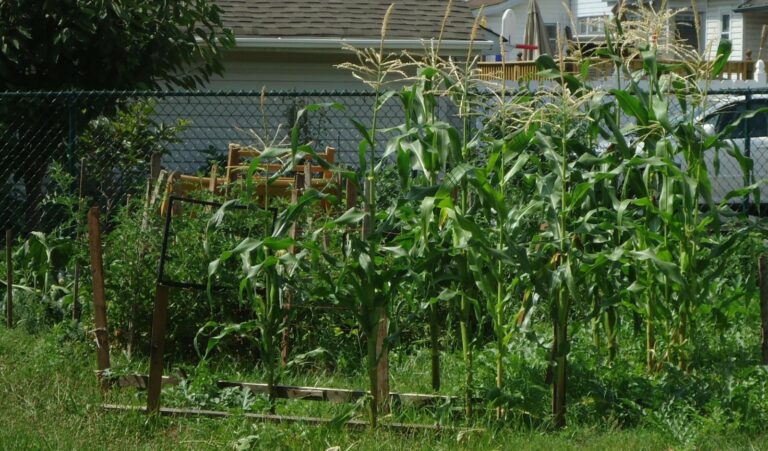
Photo: Tall corn and other vegetables growing in a fenced backyard garden. Tomwsulcer, CC0, via Wikimedia Commons
Georgia soil testing labs
| Lab | Address | Drop-off as printed | Online as printed | Turnaround as printed | Source |
|---|---|---|---|---|---|
| UGA Soil, Plant and Water Laboratory (SPW) University of Georgia Agricultural and Environmental Services Laboratories (UGA Extension) | 2400 College Station Road, Athens, Georgia 30602-9105 | Georgia clients are encouraged to visit their local Extension office for sample submission and consultation; the Extension office assists with sampling, bottles, soil bags, and fees | S1 and S2: 2-3 business days; S6: 5-7 business days | AESL Soil Analyses |
Blank cells mean the source prints nothing for that column. Contact details can change; check the lab page before sending a sample.

What a soil test costs in Georgia
| Lab | Test | Fee as printed | Includes as printed | For | Source |
|---|---|---|---|---|---|
| UGA Soil, Plant and Water Laboratory (SPW) | S1 (Routine Test) | $6.00 (additional shipping costs may apply) | PH, Lime requirement, Phosphorus, Potassium, Calcium, Magnesium, Zinc, Manganese | All | AESL Soil Analyses |
| UGA Soil, Plant and Water Laboratory (SPW) | S2 | $12.00 (additional shipping costs may apply) | Routine Test (S1) + Na, Fe, Cu, Cr, Mo, Ni, Cd, Pb + CEC (Cation Exchange Capacity) by Mehlich I sum, Percent Base Saturation | All | AESL Soil Analyses |
| UGA Soil, Plant and Water Laboratory (SPW) | S6 Organic Matter (loss on ignition, LOI) | $10.00 (additional shipping costs may apply) | All | AESL Soil Analyses | |
| UGA Soil, Plant and Water Laboratory (SPW) | Soil Test Kit | $20.00 (additional shipping costs may apply) | Soil Test Kit Instructions, sample container, prepaid mailer, and submission form | Home garden | AESL Soil Analyses |
| UGA Soil, Plant and Water Laboratory (SPW) | Soil Test Probe | $50/each | All | AESL Soil Analyses | |
| UGA Soil, Plant and Water Laboratory (SPW) | M1, Calcium Carbonate Equivalent (CCE) | $20.00 (additional shipping costs may apply) | All | AESL Miscellaneous Analyses | |
| UGA Soil, Plant and Water Laboratory (SPW) | M2, Calcium + Magnesium (test for dolomitic limestone) | $25.00 (additional shipping costs may apply) | All | AESL Miscellaneous Analyses | |
| UGA Soil, Plant and Water Laboratory (SPW) | M3, Lead (Pb) in paint chips | $36.00 (additional shipping costs may apply) | >5000 ppm indicates Pb-based paint | All | AESL Miscellaneous Analyses |
Fees are copied from the source and can change. Older publications can print different prices, so a test can appear in more than one row; the source list below gives each date.
Taking a soil sample for a Georgia lab
| Step | What the source says | Applies to | Source |
|---|---|---|---|
| How deep to sample | For lawns, sample to a depth of 4 inches. | Lawn | AESL Soil Analyses |
| How deep to sample | For gardens, ornamentals, mixed fruit trees, and wildlife plots, sample to a depth of 6 inches. | Garden | AESL Soil Analyses |
| How many cores | Collect 8-10 soil samples from each location (zone), using a zigzag approach. | All | AESL Soil Analyses |
| How many cores | For trees and shrubs, take soil samples from six to eight spots around the dripline of the plants. | Trees | AESL Soil Analyses |
| Mixing the sample | Combine and mix the cores in a plastic bucket to avoid metal contamination. | All | AESL Soil Analyses |
| How much soil to send | Take about a pint of the mixed soil and place it in the UGA soil sample bag. | All | AESL Soil Analyses |
| Container | Use the UGA soil sample bag. | All | AESL Soil Analyses |
| Labeling | Identify the sample clearly on the bag and the submission form before mailing. | All | AESL Soil Analyses |
| When to sample | Sample well in advance of planting or spring green-up, allowing time for analysis, interpretation, and fertilizer and lime application. | All | AESL Soil Analyses |
| Other sampling steps | Divide the area so each soil sample represents one plant type or condition. | All | AESL Soil Analyses |
| Other sampling steps | Use clean sampling tools and containers; never use tools or containers that have been used for fertilizer or lime. | All | AESL Soil Analyses |
| Other sampling steps | Air dry samples overnight on a flat surface lined with clean white paper, then transfer to the bag. | All | AESL Soil Analyses |
| Other sampling steps | Remove grass thatch or mulch from the ground surface before sampling; cut a slice about 1/4-inch thick and 2 inches wide. | All | AESL Soil Analyses |
| Other sampling steps | Form: include only 12 samples per form, 1 sample per line; info on bag must match form; crop and county codes must be used. | All | Soil Submission Form |
| Other sampling steps | Form: samples for Special analyses must be listed on a separate form; enclose all in the same box; soils must be dry. | All | Soil Submission Form |
Publications can disagree on depth and the number of cores, so each is its own row. Follow the lab you send the sample to.
What a Georgia soil report tells you
| What the report or publication says | Source |
|---|---|
| S1 routine test covers pH, lime requirement, P, K, Ca, Mg, Zn, Mn. | AESL Soil Analyses |
| S2 adds CEC by Mehlich I sum and percent base saturation. | AESL Soil Analyses |
| Calcium carbonate equivalent or Ca plus Mg content gives a numeric value for the effectiveness of different liming materials. | AESL Miscellaneous Analyses |
| Form asks for crop codes (up to 5) per sample and an email for returning the soil report. | Soil Submission Form |
Only what the sources print is shown. Where no pH target is printed for a crop, none is given here.
Georgia soil testing: questions
What is the fee for a home soil test in Georgia?
S1 (Routine Test) at the UGA Soil, Plant and Water Laboratory (SPW): $6.00 (additional shipping costs may apply), as printed by UGA Agricultural and Environmental Services Laboratories (UGA Extension). Other tests and older prices are in the fee table above.
How fast are soil test results in Georgia?
The UGA Soil, Plant and Water Laboratory (SPW) prints: S1 and S2: 2-3 business days; S6: 5-7 business days. Source: UGA Agricultural and Environmental Services Laboratories (UGA Extension).
What depth do you take a lawn soil sample in Georgia?
For lawns, sample to a depth of 4 inches. Source: UGA Agricultural and Environmental Services Laboratories (UGA Extension). Other sources print different depths, as shown above.
Who publishes the Georgia soil testing information?
Only UGA Cooperative Extension, state agency and other official pages are used, listed with dates below. Nothing here comes from private lab advertising, nurseries, news or blogs. Items no source prints are left out, not filled in.

Where the Georgia soil testing facts come from
- AESL Soil Analyses, UGA Agricultural and Environmental Services Laboratories (UGA Extension). Date: no date printed. Read November 18, 2026.
- AESL Miscellaneous Analyses, UGA Agricultural and Environmental Services Laboratories (UGA Extension). Date: no date printed. Read November 18, 2026.
- Soil Submission Form, UGA Agricultural and Environmental Services Laboratories (UGA Extension), AESL-SSF-21. Date: April 09, 2018. Read November 18, 2026.
Only extension services and other official agencies are used.
More for Georgia: Georgia gardening, lawn care calendar, what to plant now and planting zones.
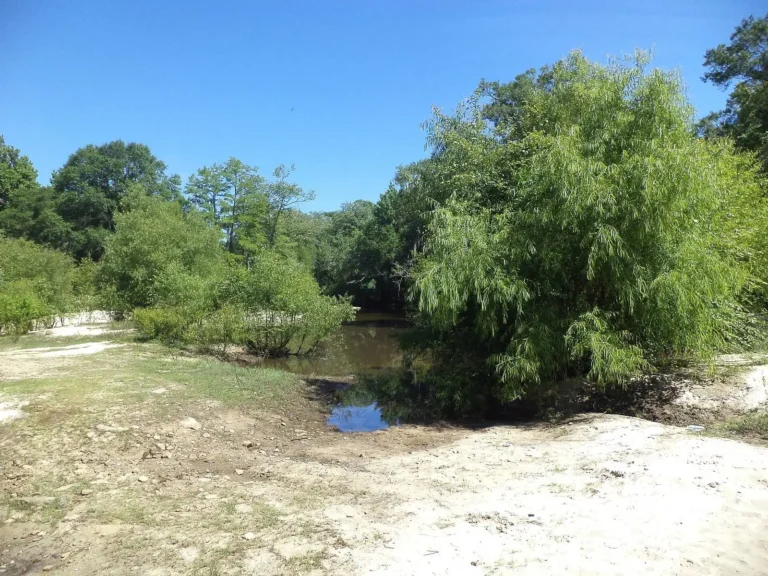
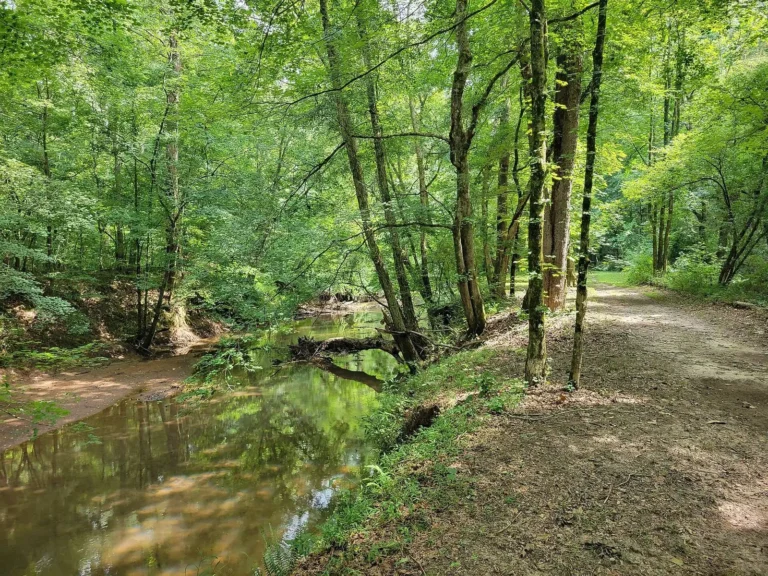
Photos: Tall corn and other vegetables growing in a fenced backyard garden: Tomwsulcer, CC0, via Wikimedia Commons; Rich Mountain rising above autumn woods seen from State Route 515 in Gilmer County: Thomson200, CC0 1.0, via Wikimedia Commons; The Flint River flowing south between spring-green banks in Dougherty County: Michael Rivera, CC BY-SA 4.0, via Wikimedia Commons; White sand bank and willows along the Little River in Lowndes County: Michael Rivera, CC BY-SA 3.0, via Wikimedia Commons; The Little Tallapoosa River winding through green spring woods in Carroll County: John Phelan, CC BY 4.0, via Wikimedia Commons.